Wednesday, November 21, 2007
उपनिदे ब्रह्म नामानि
अथातो ब्रह्म जिज्ग्य्नासा nirguna brahman, saguna brahman, karya brahman, ishvara, parameshvara, para brahman, apara brahman, paramaatma, atman.
Read the rest of this entry >>


Thursday, November 08, 2007
Some more links on Dakshinamurthy Stotram
There was a question asked in advaitin mailing list about sources of text and audio-renditions of Dakshinamurthy Stotram. This post collates some information and links, as I think it will be useful for seekers of truth.
Disambiguation: First some clarifications on what Dakshinamurthy Stotram/Stotra (also written as Dakshinamurty and Dakshinamurthi, Dakshinamurti and even Dakshinamoorthy, Dakshinamoorty, Dakshinamoorthi, Dakshinamoorti) is, because there are quite a a few of them. This post refers to a Dakshinamurthy Stotram with the shloka mouna vyakhya prakatitha parabrahma tattvam as one of its dhyana shloka, and beginning with the words vishvam darpaNa drishya maana nagari tulyam. This stotra text is included at the end of this post. This stotra is also called as "Shri Dakshinamurthy Stotram" and incorrectly referred to as Dakshinamurthy Ashtakam (probably because one of its shlokas has the word ashtakam, in an entirely different meaning). It is not an ashtakam as it has 10 verses. This stotram is extremely famous for Shri Adi Shankara its author, is said to have put in the entire Vedanta into it. A commentary on the stotram named manasollasa, was written by Sureshvara, one of Shri Adi Shankara's main disciples. This fact is surprising because commentaries are usually written for philosophical treatises, not stotras. Here is the disambiguation (1, 2, 3 and 4) by learned members of the advaitin list which confirms my understanding.
My preferred translations: A translation of this stotram is available from advaitin files as a PDF file. This translation was posted as a series of articles by Shri V. Subramanian taking it from a book from his Guru Sri D.S.Subbaramaiya, who wrote a two volume, 1200 pages commentary on a 10 verse stotram (The reader can grasp the amount of Vedanta Shri Shankara has packed into the stotram!). Another translation linked here is by Prof. VK. Though I simply cannot recommend any of these translations highly enough, it is also my opinion that it will take some time and serious effort by a sadhaka, to understand the true and complete meaning of Sri Dakshinamurthy Stotram. This is because the verses are packed with upanishadic meaning.
Other translations on the web: Here is the translation from Sanskrit docs (PDF format). Here is the one by Shri. P. R. Ramachander (which incorrectly refers to the stotram as ashtakam).
Maanasollasa sources and translation: And finally, for the really interested reader, here is the manasollasa (in Sanskrit) by Sureshvara, the famous disciple of Shri Adi Shankara [link from Sanskrit docs]. A translation of the Manasollasa, done by Swami Harshananda is available from Ramakrishna Mission book stores.
Audio commentaries on the stotram: I highly recommend the excellent audio discourses by Shri Swami Paramarthananda and Shri Swami Dayananda Saraswathi from Sastra Prakasika. They can be bought from here, with D30 being the code for the commentary by Swami Dayananda Saraswathi, and P05 for the one by Shri Paramarthananda. (I recommend the MP3 CD's, rather than audio cassettes.)
Audio links (just the stotram): Quite a few artists have done audio renditions of this stotram. Here is a audio link (more specifically, here) of the same. In this page is available another rendition. This page has another one (these last two again incorrectly refer to the stotram as ashtakam).
Transliteration: Here is a transliteration of the stotram text, done by Shri. V. Subramanian on advaitin list.
==================================================
Sri Dakshinamurthy Stotram by Adi Shankaracharya
==================================================
--- Prarthana to Shankaracharya ---
Shruti-smrti-puraanaanaam Aalayam Karunaalayam |
Namaami Bhagavatpada-Shankaram Lokashankaram ||
--- The Stotram ---
Vishwam Darpana-drshyamaana-nagarii-tulyam nijaantargatam
Pashyan aatmani maayayaa bahiriva udbhuutam yathaa nidrayaa |
Ya: saakshaat kurute prabodha-samaye svaatmaanameva advayam
Tasmai Srigurumurtaye nama idam Sridakshinamurtaye || 1 ||
Biijasyaantariva-ankuro jagadidam praang-nirvikalpam punar-
Maya-kalpita-desa-kaala-kalanaa-vaichitrya-chitrii-krtam |
Mayaviiva vijrmbhayatyapi maha-yogiva yas svecchayaa
Tasmai Sriguru-murtaye nama idam Sridakshinaamurtaye || 2 ||
Yasyaiva sphuranam sadaatmakam asatkalpaarthagam bhaasate
Saakshaat Tat-tvam-asi-iti vedavachasaa yo bodhayatyaashritaan |
Yat-saakshaat-karanaad bhaven-na punaraavrttir-bhavaambho-nidhau
Tasmai Srigurumurtaye nama idam Sridakshinamurtaye || 3 ||
Naanaa-cchidra-ghatodarasthita-mahaa-dipa-prabha-bhasvaram
Jnanam yasya tu chakshuraadi-karana-dvaara bahiH spandate |
Jaanaami-iti tameva bhaantam anu-bhaatyetat samastam jagat
Tasmai Srigurumurtaye nama idam Sridakshinamurtaye || 4 ||
Deham praanamapi indriyaanyapi chalaam buddhim cha shunyam viduH
Stri-baala-andha-jadopamaastvahamiti bhraantaa bhrsham vaadinaH |
Maayaa-shakti-vilaasa-kalpita-mahaa-vyaamoha-samhaarine
Tasmai Srigurumurtaye nama idam Sridakshinamurtaye || 5 ||
Rahu-grasta-divakarendu-sadrsho maya-samaacchaadanaat
SanmaatraH karanopasamharanato yo'bhut-sushuptaH pumaan |
Praagasvaapsamiti prabodha-samaye yaH pratyabhijnaayate
Tasmai Srigurumurtaye nama idam Sridakshinamurtaye || 6 ||
bAlyaadhiShvapi jAgradaadiShu tathA sarvAsvavasthAsvapi
vyAvR^ittaasvanuvartamaanamahamityantaH-sphurantam sadaa |
svAtmaanam prakaTIkaroti bhajatAm yo mudrayaa bhadrayaa
tasmai shrIgurumurtaye nama idam shrIdakShiNAmUrtaye || 7 ||
Vishvam pashyati kArya-kAraNatayA sva-svAmi-sambandhataH
ShiShyAchAryatayA tathaiva pitRR^I-putrAdyAtmanA bhedataH |
Svapne jAgrati vA ya eSha puruSho mAyAparibhrAmitaH
Tasmai ShrIgurumUrtaye nama idam shrIdakshiNaamUrtaye || 8 ||
bhUrambhAmsyanalo-`nilo-`mbaramahar-naatho himAmshuH pumAn-
ityAbhAti charAcharAtmakamidam yasyaiva mUrtyaShTakam |
nAnyat-kinchana vidyate vimRRishatAm yasmAt-parasmAd-vibhO-
stasmai shrIguru-mUrtaye nama idam shrIdakShiNaa-mUrtaye || 9 ||
--- Phala Sruti ---
sarvAtmatvamiti sphuTIkRRitamidam yasmAdamuShmin-stave
tEnAsya shravaNAt tadartha-mananAt dhyAnAccha sankIrtanAt |
sarvAtmatva-mahA-vibhUti-sahitam syAdIshvaratvam svataH
siddhyEt tat punaraShTadhA pariNatam chaishvaryam-avyAhatam || 10 ||
Gurave sarva-lokaanaam bhishaje bhava-roginaam |
Nidhaye sarva-vidyaanaam Dakshinaamurtaye namaH ||
========================= Om Tat Sat ================= Read the rest of this entry >>
Disambiguation: First some clarifications on what Dakshinamurthy Stotram/Stotra (also written as Dakshinamurty and Dakshinamurthi, Dakshinamurti and even Dakshinamoorthy, Dakshinamoorty, Dakshinamoorthi, Dakshinamoorti) is, because there are quite a a few of them. This post refers to a Dakshinamurthy Stotram with the shloka mouna vyakhya prakatitha parabrahma tattvam as one of its dhyana shloka, and beginning with the words vishvam darpaNa drishya maana nagari tulyam. This stotra text is included at the end of this post. This stotra is also called as "Shri Dakshinamurthy Stotram" and incorrectly referred to as Dakshinamurthy Ashtakam (probably because one of its shlokas has the word ashtakam, in an entirely different meaning). It is not an ashtakam as it has 10 verses. This stotram is extremely famous for Shri Adi Shankara its author, is said to have put in the entire Vedanta into it. A commentary on the stotram named manasollasa, was written by Sureshvara, one of Shri Adi Shankara's main disciples. This fact is surprising because commentaries are usually written for philosophical treatises, not stotras. Here is the disambiguation (1, 2, 3 and 4) by learned members of the advaitin list which confirms my understanding.
My preferred translations: A translation of this stotram is available from advaitin files as a PDF file. This translation was posted as a series of articles by Shri V. Subramanian taking it from a book from his Guru Sri D.S.Subbaramaiya, who wrote a two volume, 1200 pages commentary on a 10 verse stotram (The reader can grasp the amount of Vedanta Shri Shankara has packed into the stotram!). Another translation linked here is by Prof. VK. Though I simply cannot recommend any of these translations highly enough, it is also my opinion that it will take some time and serious effort by a sadhaka, to understand the true and complete meaning of Sri Dakshinamurthy Stotram. This is because the verses are packed with upanishadic meaning.
Other translations on the web: Here is the translation from Sanskrit docs (PDF format). Here is the one by Shri. P. R. Ramachander (which incorrectly refers to the stotram as ashtakam).
Maanasollasa sources and translation: And finally, for the really interested reader, here is the manasollasa (in Sanskrit) by Sureshvara, the famous disciple of Shri Adi Shankara [link from Sanskrit docs]. A translation of the Manasollasa, done by Swami Harshananda is available from Ramakrishna Mission book stores.
Audio commentaries on the stotram: I highly recommend the excellent audio discourses by Shri Swami Paramarthananda and Shri Swami Dayananda Saraswathi from Sastra Prakasika. They can be bought from here, with D30 being the code for the commentary by Swami Dayananda Saraswathi, and P05 for the one by Shri Paramarthananda. (I recommend the MP3 CD's, rather than audio cassettes.)
Audio links (just the stotram): Quite a few artists have done audio renditions of this stotram. Here is a audio link (more specifically, here) of the same. In this page is available another rendition. This page has another one (these last two again incorrectly refer to the stotram as ashtakam).
Transliteration: Here is a transliteration of the stotram text, done by Shri. V. Subramanian on advaitin list.
==================================================
Sri Dakshinamurthy Stotram by Adi Shankaracharya
==================================================
--- Prarthana to Shankaracharya ---
Shruti-smrti-puraanaanaam Aalayam Karunaalayam |
Namaami Bhagavatpada-Shankaram Lokashankaram ||
--- The Stotram ---
Vishwam Darpana-drshyamaana-nagarii-tulyam nijaantargatam
Pashyan aatmani maayayaa bahiriva udbhuutam yathaa nidrayaa |
Ya: saakshaat kurute prabodha-samaye svaatmaanameva advayam
Tasmai Srigurumurtaye nama idam Sridakshinamurtaye || 1 ||
Biijasyaantariva-ankuro jagadidam praang-nirvikalpam punar-
Maya-kalpita-desa-kaala-kalanaa-vaichitrya-chitrii-krtam |
Mayaviiva vijrmbhayatyapi maha-yogiva yas svecchayaa
Tasmai Sriguru-murtaye nama idam Sridakshinaamurtaye || 2 ||
Yasyaiva sphuranam sadaatmakam asatkalpaarthagam bhaasate
Saakshaat Tat-tvam-asi-iti vedavachasaa yo bodhayatyaashritaan |
Yat-saakshaat-karanaad bhaven-na punaraavrttir-bhavaambho-nidhau
Tasmai Srigurumurtaye nama idam Sridakshinamurtaye || 3 ||
Naanaa-cchidra-ghatodarasthita-mahaa-dipa-prabha-bhasvaram
Jnanam yasya tu chakshuraadi-karana-dvaara bahiH spandate |
Jaanaami-iti tameva bhaantam anu-bhaatyetat samastam jagat
Tasmai Srigurumurtaye nama idam Sridakshinamurtaye || 4 ||
Deham praanamapi indriyaanyapi chalaam buddhim cha shunyam viduH
Stri-baala-andha-jadopamaastvahamiti bhraantaa bhrsham vaadinaH |
Maayaa-shakti-vilaasa-kalpita-mahaa-vyaamoha-samhaarine
Tasmai Srigurumurtaye nama idam Sridakshinamurtaye || 5 ||
Rahu-grasta-divakarendu-sadrsho maya-samaacchaadanaat
SanmaatraH karanopasamharanato yo'bhut-sushuptaH pumaan |
Praagasvaapsamiti prabodha-samaye yaH pratyabhijnaayate
Tasmai Srigurumurtaye nama idam Sridakshinamurtaye || 6 ||
bAlyaadhiShvapi jAgradaadiShu tathA sarvAsvavasthAsvapi
vyAvR^ittaasvanuvartamaanamahamityantaH-sphurantam sadaa |
svAtmaanam prakaTIkaroti bhajatAm yo mudrayaa bhadrayaa
tasmai shrIgurumurtaye nama idam shrIdakShiNAmUrtaye || 7 ||
Vishvam pashyati kArya-kAraNatayA sva-svAmi-sambandhataH
ShiShyAchAryatayA tathaiva pitRR^I-putrAdyAtmanA bhedataH |
Svapne jAgrati vA ya eSha puruSho mAyAparibhrAmitaH
Tasmai ShrIgurumUrtaye nama idam shrIdakshiNaamUrtaye || 8 ||
bhUrambhAmsyanalo-`nilo-`mbaramahar-naatho himAmshuH pumAn-
ityAbhAti charAcharAtmakamidam yasyaiva mUrtyaShTakam |
nAnyat-kinchana vidyate vimRRishatAm yasmAt-parasmAd-vibhO-
stasmai shrIguru-mUrtaye nama idam shrIdakShiNaa-mUrtaye || 9 ||
--- Phala Sruti ---
sarvAtmatvamiti sphuTIkRRitamidam yasmAdamuShmin-stave
tEnAsya shravaNAt tadartha-mananAt dhyAnAccha sankIrtanAt |
sarvAtmatva-mahA-vibhUti-sahitam syAdIshvaratvam svataH
siddhyEt tat punaraShTadhA pariNatam chaishvaryam-avyAhatam || 10 ||
Gurave sarva-lokaanaam bhishaje bhava-roginaam |
Nidhaye sarva-vidyaanaam Dakshinaamurtaye namaH ||
========================= Om Tat Sat ================= Read the rest of this entry >>
Wednesday, November 07, 2007
Shri. Sadaji on Advaita
Replying to a question on the (again revived) thread "the three states", Shri Sadananda posts a beautiful explanation of many terms of Advaita. Read it in full!
This was posted in the same thread "the three states", in which a lengthy discussion happened on sushupthi and brahman. I have a previous post (with the title "How is sushupthi different from Brahman"), that is a notes of that thread.
Also, read Shri Ram Chandranji summarize Satya and Mithya. Read the rest of this entry >>
This was posted in the same thread "the three states", in which a lengthy discussion happened on sushupthi and brahman. I have a previous post (with the title "How is sushupthi different from Brahman"), that is a notes of that thread.
Also, read Shri Ram Chandranji summarize Satya and Mithya. Read the rest of this entry >>
Friday, November 02, 2007
100,000 to 55
A whole genre of short-stories has the theme that a story should consist of just 55 words. There is a book The World's Shortest Stories of Love and Death, which is a good read.
Our own blogosphere also had its own 55 word contributions. Read about the contributions from here.
Here is a contribution by your's truly.
Actually, the title should have been "3,200,000 to 55" The mahakaavya has 100,000 verses, mostly in anusthup (8+8+8+8) chandas. Read the rest of this entry >>
Our own blogosphere also had its own 55 word contributions. Read about the contributions from here.
Here is a contribution by your's truly.
How can they be like this? Aren't we their brothers?
Five versus hundred. Let it happen. Can we do it?
We have Truth, in person.
Oh, did all of it have to happen?
He is gone too! We are done. Let's go.
Dharma is all we are followed. Like a dog it will follow us.
Actually, the title should have been "3,200,000 to 55" The mahakaavya has 100,000 verses, mostly in anusthup (8+8+8+8) chandas. Read the rest of this entry >>
Wednesday, October 31, 2007
Bhagavad Gita and Basket Full of Water
Shri Ram Chandran, who is the owner of advaitin mailing list has posted a beautiful story on why should people read Gita. Here it is reproduced in full.
Read the rest of this entry >>
Namaste:
I have received an email with this message from a friend and the author of this story is unknown. The punch-line of this story comes at the end. This is a typical Hindu way of communicating powerful message through story (great oral tradition) by the elders to the young generation,
Enjoy!
Ram Chandran
=======================
An old Farmer lived on a farm in the mountains with his young grandson. Each morning Grandpa was up early sitting at the kitchen table reading his Bhagavad Gita. His grandson wanted to be just like him and tried to imitate him in every way he could.
One day the grandson asked, "Grandpa! I try to read the Bhagavad Gita just like you but I don't understand it, and what I do understand I forget as soon as I close the book. What good does reading the Bhagavad Gita do?"
The Grandfather quietly turned from putting coal in the stove and replied, "Take this coal basket down to the river and bring me back a basket of water."
The boy did as he was told, but all the water leaked out before he got back to the house. The grandfather laughed and said, "You'll have to move a little faster next time," and sent him back to the river with the basket to try again.
This time the boy ran faster, but again the basket was empty before he returned home. Out of breath, he told his grandfather that it was impossible to carry water in a basket, and he went to get a bucket instead. The old man said, "I don't want a bucket of water; I want a basket of water. You're just not trying hard enough," and he went out the door to watch the boy try again.
At this point, the boy knew it was impossible, but he wanted to show his grandfather that even if he ran as fast as he could, the water would leak out before he got back to the house.
The boy again dipped the basket into river and ran hard, but when he reached his grandfather the basket was again empty. Out of breath, he said, "See Grandpa, it's useless!" >
"So you think it is useless?" The old man said, "Look at the basket."
The boy looked at the basket and for the first time realized that the basket was different. It had been transformed from a dirty old coal basket and was now clean, inside and out.
"Son, that's what happens when you read the Bhagavad Gita. You might not understand or remember everything, but when you read it, you will be changed, inside and out. That is the work of Krishna in our lives"
Sunday, October 28, 2007
Tao on Problem Solving
The following excerpt on problem solving by Terence Tao (winner of last year's Fields medal), is worthwhile reading a couple of times:
The above is an excerpt from a longer article, aptly titled Terence Tao: "The Mozart of Math". Terence Tao is not just the winner of Fields medal. He has won a whole lot of prizes. Lance's post on the same subject is worthwhile reading. My earlier short post on this subject. Read the rest of this entry >>
How does Tao describe his success?
"I don't have any magical ability," he said. "I look at a problem, and it looks something like one I've already done; I think maybe the idea that worked before will work here. When nothing's working out; then I think of a small trick that makes it a little better, but still is not quite right. I play with the problem, and after a while, I figure out what's going on.
"Most mathematicians faced with a problem, will try to solve the problem directly. Even if they get it, they might not understand exactly what they did. Before I work out any details, I work on the strategy. Once I have a strategy, a very complicated problem can split up into a lot of mini-problems. I've never really been satisfied with just solving the problem; I want to see what happens if I make some changes.
"If I experiment enough, I get a deeper understanding," said Tao, whose work is supported by the David and Lucille Packard Foundation. "After a while, when something similar comes along, I get an idea of what works and what doesn't work.
"It's not about being smart or even fast," Tao added. "It's like climbing a cliff; if you're very strong and quick and have a lot of rope, it helps, but you need to devise a good route to get up there. Doing calculations quickly and knowing a lot of facts are like a rock climber with strength, quickness and good tools; you still need a plan – that's the hard part – and you have to see the bigger picture."
His views about mathematics have changed over the years.
"When I was a kid, I had a romanticized notion of mathematics -- that hard problems were solved in Eureka moments of inspiration," he said. "With me, it's always, ‘let's try this that gets me part of the way. Or, that doesn't work, so now let's try this. Oh, there's a little shortcut here.'
"You work on it long enough and you happen to make progress towards a hard problem by a back door at some point. At the end, it's usually, 'oh, I've solved the problem.'"
Tao concentrates on one math problem at a time, but keeps a couple of dozen others in the back of his mind, "hoping one day I'll figure out a way to solve them. If there's a problem that looks like I should be able to solve it but I can't, that gnaws at me."
Does theoretical mathematics have applications beyond the theory?
"Mathematicians often work on pure problems that may not have applications for 20 years -- and then a physicist or computer scientist or engineer has a real-life problem that requires the solution of a mathematical problem, and finds that someone already solved it 20 years ago," Tao said.
"When Einstein developed his theory of relativity, he needed a theory of curved space. Einstein found that a mathematician devised exactly the theory he needed more than 30 years earlier."
Will Tao become an even better mathematician in another decade or so?
"Experience helps a lot," he said. "I may get a little slower, but I'll have access to a larger database of tricks; I'll know better what will work and what won't. I'll get déjà vu more often, seeing a problem that reminds me of something."
What does Tao think of his success?
"I'm very happy," he said. "Maybe when I'm in my 60s, I'll look back at what I've done, but now I would rather work on the problems."
The above is an excerpt from a longer article, aptly titled Terence Tao: "The Mozart of Math". Terence Tao is not just the winner of Fields medal. He has won a whole lot of prizes. Lance's post on the same subject is worthwhile reading. My earlier short post on this subject. Read the rest of this entry >>
Tuesday, October 23, 2007
Sanskrit in Bhagavad Gita
I am reading the book The Bhagavad Gita by Winthrop Sargeant. It is a beautiful book, worth reading by anyone who loves both Bhagavad Gita and Sanskrit. This is what the author notes on on the Chandas used in Bhagavad Gita (Page 8):
To understand the notion of relationship between chandas and tenor, one should observe chapter 11 (as well as verses 2-5 of chapter 12) of Gita, where most of the core verses are in in "another metre". I agree with all of this, but for the names of the metre "tristubh". I know for sure the following about vedic chandas (from my Vedic Guruji):
Vedic Tristubh 11-11-11-11 = 44
Vedic Anusthup is 8-8-8-8 = 32
The question are: Is this (the chandas of the verses that Winthrop Sargeant is talking about) really tristubh? If so, is it the same as Vedic Tristubh Chandas? If it is so, does it follow the same rules (breaking of the words and the like), as Vedic verses? More importantly, "Which are the verses in the Gita, where the tenor change has been emphasized by change in Chandas? What is the meaning of the change of chandas in these verses?"
So, further research brought me to the beautiful "Sadhaka Sanjivani" by Swami Ramsukhdas. In that book, every chapter has detailed notes on the Chandas used in that particular chapter. It also has other details, like count of number times some words like "uvacha" etc. have been used and further, it has a count of number of syllables in that chapter!
Here is a tabulation of the Chandas in various chapters of the Gita, according to the information in the book:
Where
Vipula = Vipula-anusthup chandas of na/ra/bha/ma/sa or jatipaksha or sankirna variety.
Pv-Anu = Pathyavaktra-anusthup.
[Note: Both the above are varieties of Anusthup Chandas.]
Upajati = Upajati
Misc = Indravraja/upendravraja.
So, most of the verses (645/700) in Gita are in anusthup chandas, of the vipula-anusthup variety or pathyavaktra-anusthup variety. The rest of the verses (55/700) are either in upajati chandas (49/700) or in indravraja/upendravraja chandas (6/700).
Here are the various uses of upajati metre
and here are the various uses of indravraja/upendravraja
It would be interesting to know why Bhagavan Vyas used these special chandas at these particular places. Is there any deeper meaning to the use of these special chandas? Can someone explain? When asked the same questions on advaitin list, respected Shri Sadaji replies:
Read the whole reply. On a related noted, but in another thread posted some time back, respected Shri Sunderji notes:
Read the whole message and the thread. This message leaves the chandas-puzzle, if there was any in the first place, unanswered.
Also, this article from Kamakoti has some more details about chandas.
PS: Here is a place to get a very good quality PDF of Bhagavad Gita. Read the rest of this entry >>
The metre of most of stanzas of Bhagavad Gita is what is known as shloka metre, consisting of four lines of eight syllables each. The verse is blank, i.e., there are no rhymes. There are, however, a number of stanzas, particularly at dramatic moments, in which the tristubh metre, consisting of four lines of eleven syllables each, is used. The shloka is the all-purpose metre of Epics as well as much of poetry. The tristubh metre originated as the commonest metre of the Vedas, and is supposed to convey a warlike or powerful impression.
To understand the notion of relationship between chandas and tenor, one should observe chapter 11 (as well as verses 2-5 of chapter 12) of Gita, where most of the core verses are in in "another metre". I agree with all of this, but for the names of the metre "tristubh". I know for sure the following about vedic chandas (from my Vedic Guruji):
Vedic Tristubh 11-11-11-11 = 44
Vedic Anusthup is 8-8-8-8 = 32
The question are: Is this (the chandas of the verses that Winthrop Sargeant is talking about) really tristubh? If so, is it the same as Vedic Tristubh Chandas? If it is so, does it follow the same rules (breaking of the words and the like), as Vedic verses? More importantly, "Which are the verses in the Gita, where the tenor change has been emphasized by change in Chandas? What is the meaning of the change of chandas in these verses?"
So, further research brought me to the beautiful "Sadhaka Sanjivani" by Swami Ramsukhdas. In that book, every chapter has detailed notes on the Chandas used in that particular chapter. It also has other details, like count of number times some words like "uvacha" etc. have been used and further, it has a count of number of syllables in that chapter!
Here is a tabulation of the Chandas in various chapters of the Gita, according to the information in the book:
| Ch# | Verses | Vipula | Pv-Anu | Upajati | Misc |
|---|---|---|---|---|---|
| 1 | 47 | 5 | 42 | ||
| 2 | 72 | 15 | 49 | 8 | |
| 3 | 43 | 10 | 33 | ||
| 4 | 42 | 9 | 33 | ||
| 5 | 29 | 3 | 26 | ||
| 6 | 47 | 10 | 37 | ||
| 7 | 30 | 7 | 23 | ||
| 8 | 28 | 5 | 19 | 3 | 1 |
| 9 | 34 | 7 | 25 | 2 | |
| 10 | 42 | 6 | 36 | ||
| 11 | 55 | 5 | 14 | 33 | 3 |
| 12 | 20 | 3 | 17 | ||
| 13 | 34 | 5 | 29 | ||
| 14 | 27 | 7 | 20 | ||
| 15 | 20 | 5 | 10 | 3 | 2 |
| 16 | 24 | 6 | 18 | ||
| 17 | 28 | 9 | 19 | ||
| 18 | 78 | 19 | 59 |
Where
Vipula = Vipula-anusthup chandas of na/ra/bha/ma/sa or jatipaksha or sankirna variety.
Pv-Anu = Pathyavaktra-anusthup.
[Note: Both the above are varieties of Anusthup Chandas.]
Upajati = Upajati
Misc = Indravraja/upendravraja.
So, most of the verses (645/700) in Gita are in anusthup chandas, of the vipula-anusthup variety or pathyavaktra-anusthup variety. The rest of the verses (55/700) are either in upajati chandas (49/700) or in indravraja/upendravraja chandas (6/700).
Here are the various uses of upajati metre
| Chapter | Specific Verses |
|---|---|
| 2 | 5-8,20,22,29,70 |
| 8 | 9,10,11 |
| 9 | 20,21 |
| 11 | 15-27, 30-44, 46-50 |
| 15 | 2,3,4 |
and here are the various uses of indravraja/upendravraja
| Chapter | Specific Verses |
|---|---|
| 8 | 28 is indravraja |
| 11 | 28,29,45 are upendravraja |
| 15 | 5,15 are indravraja |
It would be interesting to know why Bhagavan Vyas used these special chandas at these particular places. Is there any deeper meaning to the use of these special chandas? Can someone explain? When asked the same questions on advaitin list, respected Shri Sadaji replies:
Interesting info. My understanding is sloka format normally refers to AnuShTup chandas as you pointed out. AnushTup is easy to follow since it has four quarters, as the emphasis is on the message rather the literature. Since the communication is by word of mouth, the meter is changed whenever some thing has to be emphasized or for registering a change of topic
or to draw attention to some serious point of discussion, where the student's attention is required.
...
In Telugu lot more work has been done with chandas - where the meters (like raagas) are selected to project the proper moods of the characters. But for Vedanta, emphasis is not on emotions but on understanding. anuShTup is simple and best suited and is used extensively.
Read the whole reply. On a related noted, but in another thread posted some time back, respected Shri Sunderji notes:
...
There is a legend about the composition of Mahabharata by Vyasa. Vyasa requested Ganesha to be his scribe for this opus. Ganesha agreed to do it on condition that Vyasa would do the dictation without any interruption. Vyasa accepted it, but put a counter-condition that Ganesha would not write anything that he did not understand! Ganesha too agreed.
Thus, whenever Vyasa wanted to pause for a breather, he would compose a verse like a riddle, that made Ganesha stop and think!!
There are said to be about 3400 such riddles in the @100,000 verse of the Mahabharata.
I have often wondered which some of these riddles may be in the Gita!
...
Read the whole message and the thread. This message leaves the chandas-puzzle, if there was any in the first place, unanswered.
Also, this article from Kamakoti has some more details about chandas.
PS: Here is a place to get a very good quality PDF of Bhagavad Gita. Read the rest of this entry >>
Sunday, October 21, 2007
Vijaya Dashami Shubhakaanshalu

praNo devi sarasvathi vaajEBHirvAjinIvatI | DHinAmavitriyavathu ||


May the Maya sakti who manifests herself as the Goddess of desire, Goddess of Knowledge and Goddess of action inspire the creative desire so that we realize the truth of self-knowledge. May the Goddess Kali remove our demonaic tendencies. May the Goddess Lakshmi increase our desire for Knowledge. May the Goddess Saraswathi increase our Knowledge and Wisdom so that we realize both the immanent as well as transcedental Knowledge. May the Lalitha, who is none other than the eternal Guru Dakshinamurthy grace us with the essence of Apara and Para Vidya. May the Raajareshwari, who directed the victories of Raama and Arjuna (the Vijaya) bless us with the same.
aanoBhadra kratavo yanthu adaBDhaso uparitaaso udBhidah
deeano yaTHa sadamid vrudhe asannapryuvo rakshitaaro divedive
(My good thoughts come to us from all sides, in an uninterrupted fashion, in their purest form.) Read the rest of this entry >>
Tuesday, October 16, 2007
Advaita Cartoons
Advaita Cartoons is a blog that has cartoons on Advaita. Here are a couple:
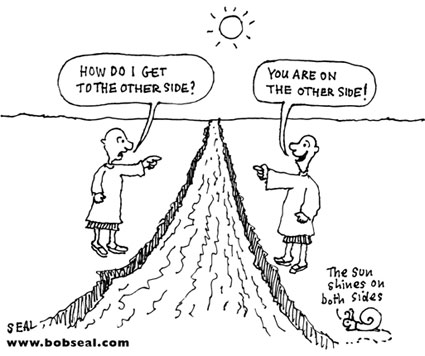
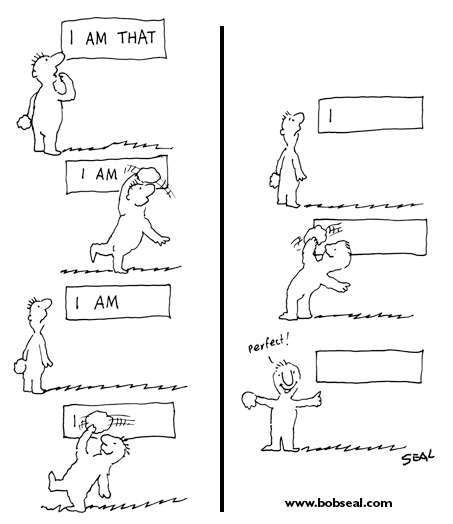
Go see all of them here. Read the rest of this entry >>
Go see all of them here. Read the rest of this entry >>
Saturday, October 13, 2007
Some references by Adi Shankara in his Brahma Sutra Bhashya
I am reading the book "Vedanta Explained (Sankara's (Shankaracharya's) Commentary on the Brahma-sutras" by Prof. V.H Date (Here is the reference.). Prof. Date is a student of Shri Ranade.
At the end of second volume, Prof. Date gives a listing of the original verses of which references have been made by Adi Shankara his Brahma Sutra Bhashya and the particular verse from Brahma Sutra where the reference has been made from. Here are the numbers of the specific verses (I am leaving out the big ones like Brihadaranyaka, Chandogya because of their sheer number.).
At the end of second volume, Prof. Date gives a listing of the original verses of which references have been made by Adi Shankara his Brahma Sutra Bhashya and the particular verse from Brahma Sutra where the reference has been made from. Here are the numbers of the specific verses (I am leaving out the big ones like Brihadaranyaka, Chandogya because of their sheer number.).
- Aitareya Aranyaka: 2.1.6, 2.2.4-6, 2.4.2-4
- Aitareya Upanishad: 1.1.1-2, 1.2,2-3, 1.3,11-13, 3.3
- Bhagavad Gita: 2.24, 2.25, 3.17, 3.35, 3.42, 4.37, 5.17, 6.11, 6.45, 7.21-22, 8.6, 8.10, 8.23, 8.26, 10.4, 10.5, 13.12, 15.6, 15.7
- Brihadaranyaka Upanishad: ...
- Chandogya Upanishad: ...
- Isavashya Upanishad: 2 and 7
- Jabalopanishad: 4.1, 5
- Kathopanishad: 1.2.6, 1.2.7, 1.2.14, 1.2.15, 1.2.18, 1.3.1, 1.3.2, 1.3.3, 1.3.4, 1.3.9, 1.3.10-11, 1.3.12, 1.3.13, 1.3.15, 2.1.1, 2.1.10, 2.1.11, 2.1.15, 2.2.8, 2.2.11, 2.3.2, 2.3.13, 2.3.16
- Kausiki Upanishad: 1.2, 1.3, 1.4, 1.7, 2.9-14, 3.2, 3.4, 3.6, 3.8, 4.18-19
- Kenopanishad: 1.3
- Manusmriti: 1.21, 2.87
- Mundakopanishad: 1.1.3, 1.1.5, 1.1.6, 1.2.11, 2.1.1, 2.1.2, 2.1.3, 2.1.8, 2.1.10, 2.2.6, 2.2.8, 2.2.10, 2.2.11, 3.1.1., 3.1.2, 3.1.3, 3.1.8, 3.1.9, 3.2.6, 3.2.7, 3.2.8. 3.2.9, 3.2.10
- Prashnopanishad: 2.3, 3.6, 3.9, 3.10, 4.9, 5.2, 6.5
- Rig Veda: 2.12.2 10.129.2
- Satapatha Brahmana: 1.3.1.26, 10,5.4.16
- Shvetashvatara Upanishad: 1.11, 1.12, 2.10, 3.8, 3.9, 4.3, 4.19, 5.8-9, 6.9, 6.11, 6.19
- Taittariya Upanishad: 1.11.2, 2.1, 2.4, 2.5, 2.6, 2.7, 2.8, 2.9
Friday, October 12, 2007
A correspondence on dreams
Some time back, a friend mailed me about dreams. I replied in the usual Vedantic fashion. Here is the correspondence.
> Good Morning ...,
> Can you please help me find the answer to the following:
> What are dreams? What do dreams mean? Why do we dream?
Dear S,
[Great to hear from you.]
"I want to know more about my dreams" is a beautiful and deep
question. Many people before us tried to find about dreams before us.
Ancient Indian philosophers, some of whom created the system of
Vedanta tried to explain dreams at least 5000-7000 years ago. The
Vedanta answer to this is pretty deep. Vedanta says that the dream
places, dream objects and dream time are nothing but mental
projections and do not exist with respect to the waking-world.
Many psychologists beginning at the turn of century, led by famous
scientists like Frued tried to answer these questions using many
experiments. Their experiments were as extensive as you can imagine
and they investigated where the mental projections came from. It is
interesting that they also came to the same conclusions that all
dreams can be explained using the past-memory/future-imagination
theory.
Think about it. For many of the things you "see/hear/feel" in a dream
have some source in your past experiences or future imaginations.
There are some dreams -- I agree *some* dreams -- that seem difficult
explaining using the past-memory/future-imagination theory. I truly
believe that they too can be explained using analysis.
Please answer this question for me: "How much time did it take for you
to realize that a dream was a dream and in a way, non-existent with
respect to the waking world?" How long did you have to think to state
for yourself, "Ah, it was all a dream!"? I would think, not more than
a short-moment. The moment that realization dawns in, all the tigers
that were about to jump on you, all the beautiful place you have gone
to seem non-existent. Is it not? Think about it.
==
The Vedantic philosophers, classified something called levels of
reality. They stated the following: "when compared to the
waking-world, the dream-world has lower level of reality". The
teachers of Vedanta, brilliant as they were, did not stop there. The
conjectured about the idea of a higher level of reality that
waking-world. In other worlds, they asked the question "what if this
whole life was a dream?" It seems like a funny idea, but it is true.
Did you watch the movie Matrix? If NOT, please watch it again (at
least 2-3 times. I am talking about Matrix-part-1 only, not 2 and 3.).
It has good special-effects, but great philosophy too. Please
concentrate on the philosophy of the movie, at least once. What
happens to Neo when he wakes up in Morpheus's cabin? He is initially
afraid, but then realizes that all his waking life was a dream. The
funny situation is when he goes back to the matrix and says: "I used
to eat in that restaurant? ..." It is funny because he *knows* that
his eating was non-existent.
The Vedantic philosophers tried to define the higher level of reality
and gave it the name Brahman. They found that it was full of Ananda or
Bliss and stated that our true nature was Brahman. In other words,
they stated that out true nature was happiness. Can you imagine the
beauty of this? Our true nature is infinite-bliss!!!
On a practical scale, they advised us to be happy all the time. That
is what I would advise you too. Happy not because we accomplished
something, happy not because something good happened by chance or
choice, but because "Happiness is our true state". Feel this and think
about it. Our true nature is nothing but Infinite bliss.
If you have more questions, please mail/call me.
regards to your family. Read the rest of this entry >>
> Good Morning ...,
> Can you please help me find the answer to the following:
> What are dreams? What do dreams mean? Why do we dream?
Dear S,
[Great to hear from you.]
"I want to know more about my dreams" is a beautiful and deep
question. Many people before us tried to find about dreams before us.
Ancient Indian philosophers, some of whom created the system of
Vedanta tried to explain dreams at least 5000-7000 years ago. The
Vedanta answer to this is pretty deep. Vedanta says that the dream
places, dream objects and dream time are nothing but mental
projections and do not exist with respect to the waking-world.
Many psychologists beginning at the turn of century, led by famous
scientists like Frued tried to answer these questions using many
experiments. Their experiments were as extensive as you can imagine
and they investigated where the mental projections came from. It is
interesting that they also came to the same conclusions that all
dreams can be explained using the past-memory/future-imagination
theory.
Think about it. For many of the things you "see/hear/feel" in a dream
have some source in your past experiences or future imaginations.
There are some dreams -- I agree *some* dreams -- that seem difficult
explaining using the past-memory/future-imagination theory. I truly
believe that they too can be explained using analysis.
Please answer this question for me: "How much time did it take for you
to realize that a dream was a dream and in a way, non-existent with
respect to the waking world?" How long did you have to think to state
for yourself, "Ah, it was all a dream!"? I would think, not more than
a short-moment. The moment that realization dawns in, all the tigers
that were about to jump on you, all the beautiful place you have gone
to seem non-existent. Is it not? Think about it.
==
The Vedantic philosophers, classified something called levels of
reality. They stated the following: "when compared to the
waking-world, the dream-world has lower level of reality". The
teachers of Vedanta, brilliant as they were, did not stop there. The
conjectured about the idea of a higher level of reality that
waking-world. In other worlds, they asked the question "what if this
whole life was a dream?" It seems like a funny idea, but it is true.
Did you watch the movie Matrix? If NOT, please watch it again (at
least 2-3 times. I am talking about Matrix-part-1 only, not 2 and 3.).
It has good special-effects, but great philosophy too. Please
concentrate on the philosophy of the movie, at least once. What
happens to Neo when he wakes up in Morpheus's cabin? He is initially
afraid, but then realizes that all his waking life was a dream. The
funny situation is when he goes back to the matrix and says: "I used
to eat in that restaurant? ..." It is funny because he *knows* that
his eating was non-existent.
The Vedantic philosophers tried to define the higher level of reality
and gave it the name Brahman. They found that it was full of Ananda or
Bliss and stated that our true nature was Brahman. In other words,
they stated that out true nature was happiness. Can you imagine the
beauty of this? Our true nature is infinite-bliss!!!
On a practical scale, they advised us to be happy all the time. That
is what I would advise you too. Happy not because we accomplished
something, happy not because something good happened by chance or
choice, but because "Happiness is our true state". Feel this and think
about it. Our true nature is nothing but Infinite bliss.
If you have more questions, please mail/call me.
regards to your family. Read the rest of this entry >>
Wednesday, October 10, 2007
Ranade: Bhagavad Gita and Upanishadic references
I am reading Shri Gurudeo R.D. Ranade's classic "A Constructive Survey of Upanishadic Philosophy" (more about the book here and here). Note that the book was written in 1926! The book is very good and scholarly (if someone like me can dare use such a qualification) and has deep philosophy explained in a clear way.
On pages 142-146, Shri Ranade makes connection between Bhagavad Gita and Katha Upanishad. To students of Vedanta, it is not a new fact that there exists heavy similarity between Katha Upanishad, but Shri Ranade being the scholar-philosopher he is, makes an exact correlation which is thorough. Further, he compares the passages in Bhagavad Gita with different Upanishads. This post is a summary of the references with some excerpts and notes. Firstly, Shri Ranade make the following note:
Here are the comparisions that Shri Ranade makes between various Upanishads and Bhagavad Gita
Krishna in Chandogya and Mahabharatha: Later, Shri Ranade analyses the references of Krishna, Son of Devaki and disciple of Ghora Angirasa in Chandogya (Ch. Up. 3.17.1-6) with Lord Krishna of Bhagavatha/Mahabharatha and says that they are different characters.
He is a great scholar indeed, to point out such seeming inconsistencies with that great authority. My simple mind however, has a simple question: Doesn't Om answer the definition of Akshita, Achyuta and Pranasamsita (indestructible, unchangeable, very edge of life)? What is wrong in thinking that the concepts in Chandogya have been put more precisely in the Bhagavad Gita? If a student has already been imparted with the knowledge of the pranava, does she not immediately associate the notions of infiniteness in space and time and beyond causality, beyond life to it because all the finite characterizations are anyway meaningless when compared to it?
Note that this passage is in serious disagreement with Shri. S.Radhakrishnan's introduction to his translation of Bhagavad Gita. In particular, Shri. Radhakrishnan uses the same argument to validate the historical aspect of Krishna. That will be covered in a later post. For now, I take a deep bow at a scholar as great as Shri. Ranade. Read the rest of this entry >>
On pages 142-146, Shri Ranade makes connection between Bhagavad Gita and Katha Upanishad. To students of Vedanta, it is not a new fact that there exists heavy similarity between Katha Upanishad, but Shri Ranade being the scholar-philosopher he is, makes an exact correlation which is thorough. Further, he compares the passages in Bhagavad Gita with different Upanishads. This post is a summary of the references with some excerpts and notes. Firstly, Shri Ranade make the following note:
There is an amount of truth in the famous verse that "The Upanishads are like a cow, Krishna is like a milk man, Arjuna like the calf that is sent to the udders of the cow before milking, and the Bhagavad Gita like the milk-nectar that is churned from the udders of the cow."
Here are the comparisions that Shri Ranade makes between various Upanishads and Bhagavad Gita
- Ka.Up 1.2.18 and BG 2.20 [Exact]
- Ka.Up 1.2.19 and BG 2.19 [Exact]
- Ka.Up 1.2.17 and BG 2.29 [Paraphrased and Adopted.]
- Ka.Up 1.2.15 and BG 8.13 [Imperishability and significance of Om. Almost word for word]
- Ch.Up 5.10.1-5 and BG 8.24 to 8.25 [Same concepts of Deyayana and Pithruyana. He notes that the former itself is from Vedas.]
- Is.Up 2 and Karma Yoga of BG:
The verse from Isavashya Upanishad (IS. 2) which tells us in a spirit of apparent contradiction that "a man should spend his life-time only in doing actions, for it is only thus that he may hope to be untainted by action" has supplied Bhagavad Gita with an idea so prolific of consequences that the Bhagavad Gita has deemed to fit to erect a whole philosophy of Karmayoga upon it.
...
This passage supplies us with the means as well as the goal of moral life, without giving the connection between them. As we shall see later, the principal theme of Bhagavad Gita is teach a life of activity coupled with the effects of actionlessness through the intermediate linkage of un-attachment to and indifference to the fruits of action. - Mun. 2.1.4 and Cosmic vision of Arjuna in BG Chapter 11. He refers that Mundaka itself may have taken its concepts from Purusha Sukta.
- Ka. Up. 1.3.10-11 has the hierarchy: senses < objects < mind < intellect < Mahat < Avyakta < Purusha, with nothing being beyond Purusha. The hierarchy in BG 3.42 is senses < mind < intellect < Purusha, which he feels is crisp.
- Asvattha of Bhagavad Gita and Katha Upanishad: Shri Ranade sas this about the Asvattha tree example in the Ka. Up and BG.
In one important respect, however, the Bhagavad Gita takes a position antagonistic to the position advanced in the Upanishads. In the Ka. Up 2.6.1, we are told that Asvattha tree is the Brahman itself, and that it is imperishable. On the other hand, the Bhagavad Gita in 15.1-4 (BG 15.1, BG 15.2 and BG 15.3-4) tells us the opposite. We shall not consider the contradictions that are introduced in this description, but we are concerned here only to find out how far this description from Bhagavad Gita agrees with the description of the Upanishad. It may be noted at once that there is an agreement between the Upanishad and the Bhagavad Gita so far as the Ashvattha tree is regarded as having its root upwards and its branches downwards. But, while the Upanishad teaches that the Ashvattha tree is real, and identical with the Brahman and therefore impossible to cut off, the Bhagavad Gita teaches that the Ashvattha tree must be regarded as unreal, and as unidentical with the existence, and therefore that it is necessary to cut off this tree of existence by the potent weapon of non-attachment.
I am sure at a peripheral level, the difference are huge and bound to confuse the beginner. But I have a simple question: Is not the method of defining things using contradictions, exactly the method employed by Vedantic teachers? If we define Brahman as something, does it remain brahman anymore? If the anirvachaniya maya is tried to define as something, does it not escape that definition? Points to ponder (for me, that is!).
Krishna in Chandogya and Mahabharatha: Later, Shri Ranade analyses the references of Krishna, Son of Devaki and disciple of Ghora Angirasa in Chandogya (Ch. Up. 3.17.1-6) with Lord Krishna of Bhagavatha/Mahabharatha and says that they are different characters.
While no mention is made whatsoever of Ghora Angirasa who was the teacher of Krishna in Chandogya. Such a fact cannot be easily ingored in a work like Mahabharatha which is expected to give us everything about the divine warrior Krishna, and not not leave the name of the teacher unmentioned. If the Krishna of Chandogya is identified with the Krishna of Mahabharatha, for that matter why should not we identify the Harischandra of the Aitareya Brahmana who had a hundred wifes with the Harishchandra of mythology who had only one wife? Mere similarity of name proves nothing. It fills one with humour that new facile philosophy of identifications brahmana-wise should have been instituted in modern times by a host of critics of no small calibre when they would raise a huge structure of mythico-imaginary identifications by rolling together the god Vishnu of Vedic repute, Narayana the Cosmic God, Krishna the pupil of Ghora Angirasa, and Vasudeva the founder of a new religion, and thus try to prove that the sources of religion of Bhagavad Gita are found in the teaching of Ghora Angirasa! There would seem to be some meaning, however in the attempted identification of the Krishna of Chandogya with Krishna of the Bhagavad Gita when in verse 4 of the passage we are discussing [Ch. Up. 3.1-6], we are told that the gifts which such a sacrificier should make to priests are those of the following virtues: Tapas, Danam, Arjavam, Ahimsa and Satyavachanam. This list is closely similar to the list of virtues enumerated in BG16. 1-2 where the same virrtues are enumerated along with a number of other virtues, and almost the same order. But this fact proves nothing, because, as we have pointed out in the preceeding paragraphs, the Bhagavad Gita is a congeries of quotations, phrases and ideas borrowed from the Upanishads, and it is only by accident, as we may say, that the five virtues mentiones above should have been enumerated in the Upanishadic passage where Krishna, the son of Devaki is mentioned. There is a stoty about the Delphic Oracle that a number of trophies were hung round about the temple in praise of the god who had saved so many souls at different times from shipwreck in the midst of waters. A philosopher went to the temple and asked, Yea, but where are those that are drowned? Similarly we may say about the virtues in the Chandogya passage which are identical with the virtues in the passage from Bhagavad Gita. True, that the virtues enumerated in the Chandogya almost correspond to the virtues enumerated in the Bhagavad Gita: but, why, for the world, should not the essence of teachings of Ghora Angirasa have been incorporated, when the Upanishadic passage tells that at the last moments of a man's life, he should take the resort to these three thoughts: Thou art indestructible, Thou art Unchangeable, Thou art the very edge of life? Why should not the Bhagavad Gita have profited from these three expressions: Akshita, Achyuta and Pranasamsita? Why shoud it have left us merely with advise that a man should utter Om at the time of his death and meditate upon God? Finally we may say that the burden of proof of the identification of the two Krishnas falls upon those who make the assertion and so fas as their arguments have gone, we donot think that they have, in any way, proved identification at all.
He is a great scholar indeed, to point out such seeming inconsistencies with that great authority. My simple mind however, has a simple question: Doesn't Om answer the definition of Akshita, Achyuta and Pranasamsita (indestructible, unchangeable, very edge of life)? What is wrong in thinking that the concepts in Chandogya have been put more precisely in the Bhagavad Gita? If a student has already been imparted with the knowledge of the pranava, does she not immediately associate the notions of infiniteness in space and time and beyond causality, beyond life to it because all the finite characterizations are anyway meaningless when compared to it?
Note that this passage is in serious disagreement with Shri. S.Radhakrishnan's introduction to his translation of Bhagavad Gita. In particular, Shri. Radhakrishnan uses the same argument to validate the historical aspect of Krishna. That will be covered in a later post. For now, I take a deep bow at a scholar as great as Shri. Ranade. Read the rest of this entry >>
Friday, September 28, 2007
Sruti Gita and Other Links
Here are a few links:
Sruti Gita: In chapter 10-87 of the Bhagavatham, Vedas sang the praise of the Lord in his nirguNa state at the beginning of creation, even before the creator Brahma had been created. It is called "Sruti Gita" or "Veda Struti" from Bhagavatham. Here is a good introduction and translation from Prof. VK Here is a link from Vedabase.
Sanatsujatiyam: Shri. S. N. Sastry, a reputed scholar and regular poster to advaitin mailing list has completed part 2 of his translation of Sanatsujatiyam. Here are the pdf links (part 1 and part 2.) Here is Prof. VK's translation of Sanatsujatiyam.
RigVeda and the Indian Systems of Approach to the One: I was searching at advaitin archives/files for any translations of verses from Rig Veda verses in light of Advaita. Shri Himanshu Dave (in 2000) posted a series of excellent articles with the title "RigVeda and the Indian Systems of Approach to the One". Included are excellent explanations to many famous verses from Rig Veda. Here is the link to those files. More links to posts which talk about Vedas are in this post by Shri. Ram Chandran. Also, to a question by Dr. Sadananda, "Why should we read Rig Veda and why should we inquire so much into the symbolism within, when at the same time Upanishads (clearly the flowers from Vedas) and are easier to understand and talk to us more directly?", the reply by Prof. Dave is worthwhile reading.
PS Also worth reading is this article.
A beautiful story about Radha and Krishna: Krishna - Nitya Brahmachari retold by Shri P. R. Ramachander, who posts to the advaitin mailing list. Also here is my post on the same topic, which was excerpted from Raja Rao's Serpent and the Rope. Read the rest of this entry >>
Sruti Gita: In chapter 10-87 of the Bhagavatham, Vedas sang the praise of the Lord in his nirguNa state at the beginning of creation, even before the creator Brahma had been created. It is called "Sruti Gita" or "Veda Struti" from Bhagavatham. Here is a good introduction and translation from Prof. VK Here is a link from Vedabase.
Sanatsujatiyam: Shri. S. N. Sastry, a reputed scholar and regular poster to advaitin mailing list has completed part 2 of his translation of Sanatsujatiyam. Here are the pdf links (part 1 and part 2.) Here is Prof. VK's translation of Sanatsujatiyam.
RigVeda and the Indian Systems of Approach to the One: I was searching at advaitin archives/files for any translations of verses from Rig Veda verses in light of Advaita. Shri Himanshu Dave (in 2000) posted a series of excellent articles with the title "RigVeda and the Indian Systems of Approach to the One". Included are excellent explanations to many famous verses from Rig Veda. Here is the link to those files. More links to posts which talk about Vedas are in this post by Shri. Ram Chandran. Also, to a question by Dr. Sadananda, "Why should we read Rig Veda and why should we inquire so much into the symbolism within, when at the same time Upanishads (clearly the flowers from Vedas) and are easier to understand and talk to us more directly?", the reply by Prof. Dave is worthwhile reading.
PS Also worth reading is this article.
A beautiful story about Radha and Krishna: Krishna - Nitya Brahmachari retold by Shri P. R. Ramachander, who posts to the advaitin mailing list. Also here is my post on the same topic, which was excerpted from Raja Rao's Serpent and the Rope. Read the rest of this entry >>
Saturday, September 15, 2007
Happy Ganesh caturthi!

May the Ganesh, who is the lord of all Ganas dance to stomp away your obstacles and make you see the light that you truly are beyond the senses, truly beyond the emotional mind and truly beyond the perception of intellectual discrimination of the mind.
May give you the right knowledge and the wisdom beyond it. May the one who is beyond the four layers of speech make you understand all of them.
rtam vacmi satyam vacmi! (from Ganesh Atharvasirsha Upanishad)! Read the rest of this entry >>
sushupti and brahman
Om Gam Ganapathaye Namah!
There is some excellent discussion in advaitin yahoo group about Avasthya Traya that is worth following closely.
==
Some references
Shankara's commentaries on Mandukya, Chandogya and Brihadaranyaka. Translations by Nikhilananda. [I used Dr. Radhakrishnan's Upanishads/Brahma-Sutra commentary for cross-checking.]
Specific references:
Looks like people also used these translations of Brahma-Sutra.
Note: This post will be updated when more posts come up. Read the rest of this entry >>
There is some excellent discussion in advaitin yahoo group about Avasthya Traya that is worth following closely.
- To answer some questions, Dr. Sadananda eloquently explains the avasthya-traya.
- The question, comes up (in the follow-up mails): "What is the source of happiness that one experiences after sushupthi?" If a person says after sushupti "I feel happy", what is the souce of the happiness? Is it union with Brahman? If it is union with Brahman, is the union with Brahman complete? If so, why? If not a complete union with Brahman, where is the happiness coming from? sushupti is clearly a state of ignorance. What happens to the adjuncts during the sushupti? [I have an ancillary question regarding this: How can the happiness experienced during sushupthi be compared with the union of a sense-organ with the desired object? Simple examples for these are satisfaction of hunger after eating food.]
- One "Sampath from Hyderabad", a 20 year old (!!!) with the tag "paramahamsavivekananda" explains the relevant passages from Brahma-sutra Bhashya of Shri Shankara. [Refers to B.S.B 3.2.9, M.Up.S.B 5, M.Up.7, ]
- The topic shifts to the other thread, titled "The three states".
- Br. Vinayaka asks some questions and Shri Sampath answers them withr reference to Adi Shankara's Brahma Sutra Bhashya. [The post has quite a few interesting points.] [New references: M.Up.6,7, B.G. 14.19]
- More questions by Br. Vinayaka and more answers by Shri. Sampath. [New references: Br.Up.4.3.32.S.B, B.S. 2.3.29, Mun.Up. 3.1.9, B.S.2.3.30, Ch.Up.6.8.1, B.S. 2.3.31, Kh.Up. VI,9,2;3, Pai.Up. 2.8, 2.9, 2.13, 4.15, 4.16, 4.17, B.S. 1.3.42, Br. Up. 4.3.7, B.S.1.3.8, ]
- Worthwhile reading posts: by Dr. Sadananda: "absence of duality may be bliss but there is no knowledge ones real nature in that sushhupti state. Otherwise everybody will get up with knowledge after deep sleep state."
- Prof. VK refers to Shri Sampath an "Abhinava-Shankara" and blesses him saying "As one much elder to you let me bless you with 'vedoktA AshiShaH'." [Read the post for an important excerpt.]
- Shri. S.N. Sastri clarifies that nowhere did he say that "there is no ignorance in deep-sleep" and Shri. Ram Chandran points to some passages from Atmabodha (verses #53-57). [References: B.S. 3.2.9]
- Shri. S.N. Sastri also points to the references in Shankara's commentary where there is an apparent contradiction. "In Br. Up. 4.3.21 *The above passage is in the context of deep sleep and says that the jIIva is freed from avidyA during deep sleep.*" seems to contradict the following "In Ch.up. 8.3.2 it is clearly said that there is avidyA in deep sleep". [References: Br.Up. 4.3.21, Ch. Up. 8.3.2, Br.S.B. 3.2.9, S.S.3.123-3.125, B.S.B. 1.4.18]
- Br. Vinayaka has more questions and Shri Sampath answers, with a punch line: "the temporary union with Brahman is because of the obliteration of vishepa shakti of avidyA and coming back into the world is because of its avaraNa shakti." [Ch. Up 6.8.1, B.S.B. 2.3.31, Br.Up. 4.3.32, 4.3.22, 4.3.7,4.3.[17-18], 4.3.23]
- Some clarification asked by Shri Bharkarji and some replies by Shri Sampath. [Ch.Up. 8.3.2]
- Some questions by bhagni Nivedita on the rope-snake illusion and some apt answers by Shri Sampath. [References: Ch.Up. 6.2.2-3, Ait.Up 1.1.1]
- Br. Vinayaka brings up some verses from Upadesha Sahasri (with the quote "Some Swamis like Sri SSS, Swami Dayananda Saraswati opine that it is the only prakaraNa grantha written by shankara.") and Shri Sampath answers, with an interpretation of a description of Br. Up and with an brilliant observation "Sri Bhaskarji in his post said that the non cognition of multiplicity is due to the union with Brahman. This is "NOT FALSE". In some way, it is true, but the actual thing must be IMHO, ** The union itself occurs because of the cessation of multiplicity.**". [References: Br.Up. 4.3.19: hawk analogy]
- Br. Vinayaka summarizes some points with an intent to conclude the thread. He does not agree with avidya in deep-sleep. Also, he states that (i) there is complete union of the jiva with brahman in sushupthi and (ii) there is no contradiction in the passages that Shri Sampath quotes above ("I don't see any contradiction in the first palce. Like other shruti passages shruti is telling here that, you hugged brahman itself you don't know after you woke up.").
- Shri Bhaskarji asks asks couple of *VERY* important questions ("you are saying *avidyA*, in sushupti, is granting the permission to jiVa to unite with brahman!! ... Is the turIya what you are referring is something specially designed exalted state like *nirvikalpa samAdhi*?? Though you have not specifically mentioned *turIya is nirvikalpa samAdhi*, prabhuji, I think I've valid references from your recent mails to infer that you are advocating the 4th state called turIya as something strange state which is exclusive of our normal three avasthA-s") and Shri Sampath answers ("mahASaya, IMHO, turIya iss NOT AT ALL A STATE. It can be a state to the ajNAni who observes a sage experience it. This idea of attributing "State" to everything we see itself denotes that we are conditioned by avidyA. So, I feel, turIyA is not a state and it is the true nature of Brahman beyond all the three states which can only be reached by a sAdhaka through apavAda leading to the Conscious identity with his own true Self.") and asks the question that started the whole thing ("What is the cause for the "UNION with Brahman" to occur in Deep Sleep? ")
- Shri Shyam explains in a beautiful post, in simple words (using upanishadic concepts like panchakosha etc, and upanishadic examples like uddalaka/aruni, indra/prajapathi) the meaning of the three states. Shri Sampath responds, with a couple of examples -- small pot immersed in a big pot -- and restates his question ("tell me the reason for such a merger (or) ceasing from the not-self identification which is said to occur in the deep sleep."). Here is more.
- *MUST READ* Shri Sadananda explains in an eloquent post many things. His post corrects many statements made by other posters and has some gems. *MUST READ*.
- Shri Ananda Wood responds and summarizes ("it is the thinking mind that sleeps, not knowing consciousness"). Shri S. N. Sastri points to an (apparent) difference of opinion and Shri Ram Chandran also adds in.
- Shri Sampath brings in more references to enforce his POV ("Here is a very important and conclusive evidence from SrI Sankara's own words in Brahma Sutra Bhashya where he has explicitly said that avidyA exists in a potential form during Deep Sleep.") [B.S.B. 2.1.8, 2.1.9]. Shri Baskaran brings references from Swami Nikhilananda's book on Mandukya, chapter 1 verse 5 ("In deep sleep all the diversified experiences of waking and dreaming, which are nothing but the activities of the mind reach the state of non discrimination
... This unified experience of deep sleep is different from the unity experienced from the knowledge of Brahman; for in the waking and dream state that follows it, one again takes multiplicity to be real. In deep sleep no specific knowledge is present. ... and .. friction caused by subject-object relationship is absent. All efforts disappear and one in deep sleep experiences bliss, said to be happy. This bliss is quite different from that of Brahman.""). He also brings in his notes from Swami Paramarthananda ("In shusupthi, a nirvikalpa rupa everything gets resolved into one, an experience through kaarana sariram. In this state the jagrat and swapna states are negated and jeeva is ignorant of himself in that state. The basic difference is that in nidithyasanam he is aware of himself as "aham brahma asmi". In fact in jagrath avastha also he is asleep to his nature. The Kshetragna is same in all the three states. Even though the pramata, prameyam and pramanam are not experienced they get resolved as unmanifest condition –a maya aspect. There is no absence since they come back again on waking up. It is saturated with ananda associated with the experiencer –karana sariram, where duality, ragadveshas are all resolved. The very experience of absence of experience in which there is sukham the thriputies are not clearly defined/felt. It is also to be understood that in all the three stages there involves withdrawal and entry in to the stages."")
==
Some references
Shankara's commentaries on Mandukya, Chandogya and Brihadaranyaka. Translations by Nikhilananda. [I used Dr. Radhakrishnan's Upanishads/Brahma-Sutra commentary for cross-checking.]
Specific references:
Looks like people also used these translations of Brahma-Sutra.
Note: This post will be updated when more posts come up. Read the rest of this entry >>
Friday, September 14, 2007
A Great Mystic
Tagore has been written as a beautiful poet and mysic and nature lover. But who else but a great advaitin, one who can meditate for hours on the nature
Who else, but a great self-realizer can immerse himself into the wonder that is mother nature?
Thanks to Shri Sadandaji whose reference lead me to read the book after a long time. The conversation on advaitin list that lead to this comment ("You should read Gitanjali by Tagore") is also worthwhile, with its subject ("Why is Krishna not visible to us?") Someone was asking on the advaiting list, There were some, who gave the harsh reply. But Shri. Sadanandaji who (along with Prof. V. Krishnamurthy) coined the term "Advaita inspite of duality" gives the above reply and the following one too:
Read the full reply!
Post script (a couple of weeks later). Bhaskarji started reading ""Collected Works of Bhagawan Ramana Maharishi", thinking about "Who am I" and posted the following. Is the result a surprise? "Seek and Ye Shall Find" Read the rest of this entry >>
`Every morning at three---I know, for I have seen it'---one said to me, `he sits immovable in contemplation, and for two hours does not awake from his reverie upon the nature of God. His father, the Maha Rishi, would sometimes sit there all through the next day; once, upon a river, he fell into contemplation because of the beauty of the landscape, and the rowers waited for eight hours before they could continue their journey.' [link]
Who else, but a great self-realizer can immerse himself into the wonder that is mother nature?
Thanks to Shri Sadandaji whose reference lead me to read the book after a long time. The conversation on advaitin list that lead to this comment ("You should read Gitanjali by Tagore") is also worthwhile, with its subject ("Why is Krishna not visible to us?") Someone was asking on the advaiting list, There were some, who gave the harsh reply. But Shri. Sadanandaji who (along with Prof. V. Krishnamurthy) coined the term "Advaita inspite of duality" gives the above reply and the following one too:
It is like asking, closing my eyes - how come I do not see the light - better yet wearing think dark glasses and asking why it is very dark here.
To see Krishna is to recognize Krishna in what I see, or his presence, not looking for Krishna. It is seeing Krishna present everywhere and in everything, starting from himself.
We get carried away with forms and names and forget
the substantive Krishna that is there in all names and
forms.
...
How can I not see Krishna? Where can I not see Krishna?
Read the full reply!
Post script (a couple of weeks later). Bhaskarji started reading ""Collected Works of Bhagawan Ramana Maharishi", thinking about "Who am I" and posted the following. Is the result a surprise? "Seek and Ye Shall Find" Read the rest of this entry >>
Monday, September 10, 2007
Hans Rosling
Whatever you do, please watch the talks by Hans Rosling at TED. First, the talk he gave in 2006. Then the talk he gave in 2007 (with a surprise ending!).
The tool he is built for this talk -- with his family-members is http://tools.google.com/gapminder/. My recommendation, play with it to compare India with other countries. [The software was later bought by Google.] Read the rest of this entry >>
The tool he is built for this talk -- with his family-members is http://tools.google.com/gapminder/. My recommendation, play with it to compare India with other countries. [The software was later bought by Google.] Read the rest of this entry >>
Saturday, September 01, 2007


Saturday, August 11, 2007
The Lost Years of Lord Rama?
Lord Rama in the initial years of his vanavaasa (exile) spent with Bharadvaaja, Sarabhanga, Sutikshana. These add up to no more than one year. [Source Vaalmiki Ramayana].
The last part of his exile started with his moving to Panchavati, where He fought with Khara-Dushana and ended with the killing of Maricha and abduction of Sita. This last part is no more than 6-8 months (source Vaalmiki Ramanaya).
It does not hurt our main thesis, even if we add up the total time of the above two periods to be around two years. The question remains: What did he exactly do during the intervening years? What Sadhana did he do? It can be assumed that He (with Sita and Lakshmana) went around in the Ashram's of Maharshi's. What did Rama learn during those years? What did he teach during those years? What did he do during those years? The question is important in a Vedantic perspective. Assuming a Vishnu incarnation, who chooses to bear the difficulties of "ordinary men", assuming that the killing of Asuras was easy for him (because of his incarnation as well as his previous learning from Vishvamitra et al) and needed no prior preparation and particular sadhana, What did the supreme being do in human form do?
Kind reader: please help me answering these questions.
The Vaalmiki Ramayana does not talk much about these years. All it says is "He spent time with Maharshis for 10 or so years." What else happened?
The Adhyatma Ramanaya may talk, but in a way is contradictory to the premise of the question. This is because, in Adhyama Ramayana, Rama is Vishnu, the para Brahman himself. Applying doership of Karma -- however sacred it is, like Sadhana and learning -- is far from contraditions (my opinion). So my question stands. [I would however verify more on this, the moment I get a copy of Adhyama Ramayana in my hands.] Read the rest of this entry >>
The last part of his exile started with his moving to Panchavati, where He fought with Khara-Dushana and ended with the killing of Maricha and abduction of Sita. This last part is no more than 6-8 months (source Vaalmiki Ramanaya).
It does not hurt our main thesis, even if we add up the total time of the above two periods to be around two years. The question remains: What did he exactly do during the intervening years? What Sadhana did he do? It can be assumed that He (with Sita and Lakshmana) went around in the Ashram's of Maharshi's. What did Rama learn during those years? What did he teach during those years? What did he do during those years? The question is important in a Vedantic perspective. Assuming a Vishnu incarnation, who chooses to bear the difficulties of "ordinary men", assuming that the killing of Asuras was easy for him (because of his incarnation as well as his previous learning from Vishvamitra et al) and needed no prior preparation and particular sadhana, What did the supreme being do in human form do?
Kind reader: please help me answering these questions.
The Vaalmiki Ramayana does not talk much about these years. All it says is "He spent time with Maharshis for 10 or so years." What else happened?
The Adhyatma Ramanaya may talk, but in a way is contradictory to the premise of the question. This is because, in Adhyama Ramayana, Rama is Vishnu, the para Brahman himself. Applying doership of Karma -- however sacred it is, like Sadhana and learning -- is far from contraditions (my opinion). So my question stands. [I would however verify more on this, the moment I get a copy of Adhyama Ramayana in my hands.] Read the rest of this entry >>
Thursday, August 09, 2007
Advaita Practise
The noise must be interrupted for some practical links on practise of Advaita! A reader asks on advaitin mailing list:
Beautiful question indeed! As replies to the question, great Advaitins -- whom I respect a lot for their writings -- have replied and the replies deserve to be read in full. Read the reponses by Shri. Kuntimaddi Sadananda and the one by Prof. V. Krishnamurthy. Read the rest of this entry >>
What does practise of Advaita mean? Is is just understanding that Jiva is Brahman? What does that understanding mean in practical life? How does an Advaitin live?.
Beautiful question indeed! As replies to the question, great Advaitins -- whom I respect a lot for their writings -- have replied and the replies deserve to be read in full. Read the reponses by Shri. Kuntimaddi Sadananda and the one by Prof. V. Krishnamurthy. Read the rest of this entry >>
Subscribe to:
Posts (Atom)


 Posts
Posts

